

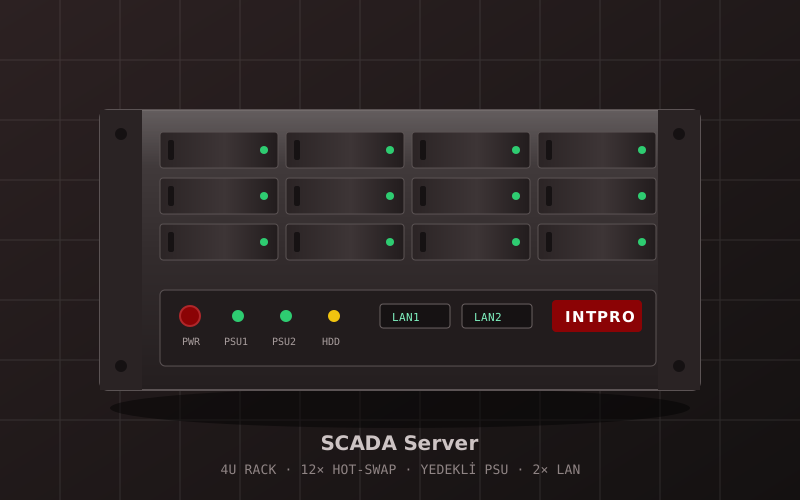
The SCADA server runs continuously in a substation; if it stops, the site can no longer be monitored. Office-grade computers are therefore unsuitable — hardware with a redundant power supply, hot-swap drive bays, a rack-mount chassis and a long-life industrial mainboard should be chosen instead. The configuration below is sized for switchyard SCADA and turbine SCADA applications under real field conditions.
Standard configuration
| Component | Specification |
|---|---|
| Chassis | 4U rack mount, 12× 2.5"/3.5" hot-swap SATA/SAS bays |
| Power supply | Redundant 550 W PSU |
| Mainboard | LGA1151 ATX Q370 · 2× LAN · DP / DVI / VGA |
| CPU | Intel Core i7-8700 — 3.2 GHz base / 4.6 GHz turbo, 12 MB, 6C/12T |
| Memory | 2× 8 GB DDR4-2666 |
| Storage | 2× 3.5" HDD 1 TB + 2× 2.5" SSD 240 GB |
| Graphics | GT1030 2GD4 LP OC — 2 GB DDR4, 1× HDMI, 1× DVI |
| Cable | 3×0.75 mm² power cord, 1.8 m, EU plug |
| Operating system | Windows 11 Pro 64-bit |
Highlights
- Redundant 550 W power supply — the system keeps running even if one module fails.
- 12 hot-swap SATA/SAS bays, suitable for RAID 1 / RAID 10 layouts.
- Two independent LAN ports, physically separating the SCADA network from the corporate network.
- 4U rack-mount chassis that fits straight into an existing telecom cabinet.
- A discrete graphics card supports a multi-monitor operator console (HDMI + DVI).
- Delivered with the operating system installed and licensed; SCADA software is loaded within the project scope.