

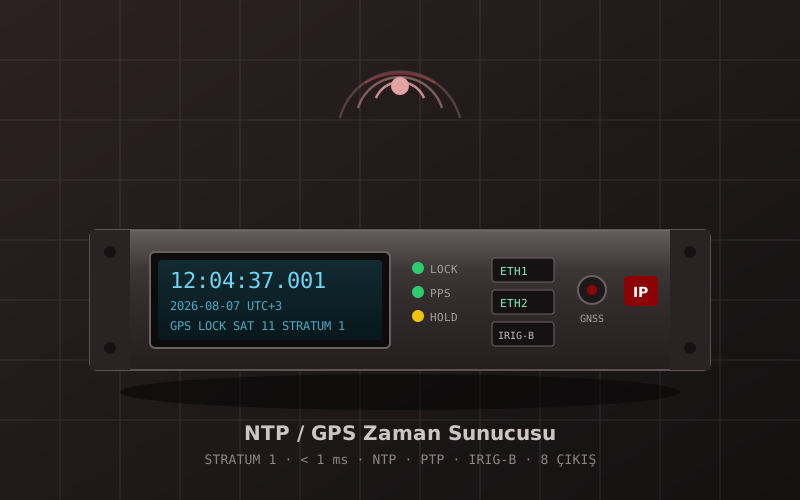
What is NTP?
NTP (Network Time Protocol) is the standard protocol used to synchronise the clocks of all devices on a network to a common, accurate time source. It measures the round-trip delay between server and client to compensate for network latency, achieving millisecond accuracy on a local network and microsecond accuracy in well-designed systems. NTP is hierarchical: servers connected directly to a reference clock (GPS, atomic clock) are “stratum 1”, and those taking time from them are “stratum 2”.
Why it matters in the energy sector
Fault analysis in a substation depends on knowing the order in which events occurred. If the clocks of the protection relays, the RTU, the fault recorders and the SCADA server drift apart, the sequence of events (SOE) records become meaningless and the root cause cannot be identified. Every intelligent electronic device (IED) at the site must therefore be fed from a single time server.
Technical specification
- Time source
- GPS / GNSS antenna synchronisation — stratum 1 operation
- Accuracy
- Better than 1 ms synchronisation accuracy
- Time outputs
- 8 independent outputs
- Display
- Built-in LCD — date, time, satellite count and lock status
- Protocols
- NTPv4, SNTP; PTP (IEEE 1588) and IRIG-B where required
- Holdover
- Internal oscillator maintains accuracy when the antenna signal is lost
- Interfaces
- Ethernet (RJ45); redundant network port option
- Standards
- Compatible with IEC 61850 based substation automation
- Power supply
- 48 / 110 / 220 VDC or 220 VAC; redundant supply option
- Enclosure
- 19" rack mount, 1U
- Origin
- 100% domestic design and production
Systems that benefit from time synchronisation
- Protection relays and IEDs
- RTUs and SCADA servers
- Fault recorders
- Power analysers and meters
- Industrial switches and network devices
- CCTV and security systems